Jim Alexander: Will this World Cup also be transformative?
Published in Soccer
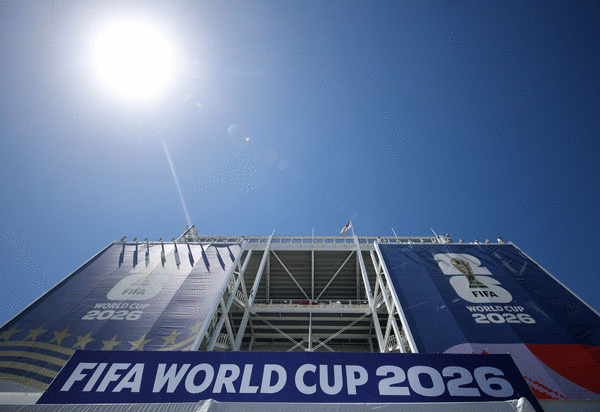
This is part of what we were hearing 32 years ago this month, as the last World Cup on these shores drew near:
“If the U.S. does well, it will show that U.S. players can compete at the highest level.”
That particular quote came from an executive from a local indoor soccer team, the Anaheim Splash. Tim Orchard, who was then the director of player personnel for a team that had played in the Forum the previous season in something called the Continental Indoor Soccer League, also told me: “And that will have a tremendous impact on us.”
Sound familiar?
Flash forward to today: The soccer landscape in this country is much different than it was in ’94. Major League Soccer, the first-division league formed as a condition of that tournament being awarded to the U.S., has been around for 30 years and the vast majority of its teams now play in soccer-specific facilities. The sport is one of the five major spectator sports in America, according to a number of surveys, and some estimates have it as high as No. 3.
(MLB and the NHL would like a word.)
The U.S. men’s national team in 1994 basically was a bunch of former college players under the direction of Serbian coach Bora Milutinovic, who somehow got this roster into the knockout round after the U.S. had gone three-and-out in 1990 in Italy, its first World Cup appearance in 40 years.
People in the United States who cared at all about the sport were convinced then that a successful World Cup at home would transform the sport in this country. Which it did, sort of.
Part of the mission behind MLS was to develop talent for the national team, and it — along with increased domestic interest in Europe’s top leagues — has undeniably increased the fan base. And there is a sizable contingent of Americans playing in Europe, which seemed almost unthinkable in 1994.
Consider: Of the 26-man roster that will open the 2026 World Cup Friday evening against Paraguay at SoFi Stadium in Inglewood, 17 players compete in European leagues, Alex Zendejas plays for Mexico’s Club América, and the other eight, including all three goalkeepers, play in MLS.
(Incidentally, FIFA can call the stadium what it wants, but feel free not to refer to it as “Los Angeles Stadium.”)
Yet we hear similar talk going into this tournament as we did in 1994, about how U.S. success would help put the sport over the top, though not to the same degree because there was so much more ground to make up then. Much of the soccer culture in this country leading up to that first World Cup was represented in parks throughout suburban America on Saturday mornings, thanks to AYSO.
(And yes, before you ask, I was one of those soccer dads. All hail the Powerful Termites!)
Our Boys’ performance in ’94 — tying Switzerland 1-1 in the Pontiac Silverdome and beating Colombia 2-1 at the Rose Bowl to reach the round of 16 for the first time since 1934, and then giving eventual champ Brazil all it could handle in a 1-0 loss at Stanford — almost certainly spurred the interest that ultimately led to so many American players landing overseas.
But what it hasn’t done is turn the U.S. into a men’s soccer power. (As for the women, who won their first of four World Cup titles in 1991? Another story altogether.)
The men overachieved in ’94 — with the help of a Colombian own-goal that had a tragic aftermath — and all these years later we still second-guess Bora for playing rope-a-dope with the Brazilians in the second half that afternoon at Stanford.
They went three-and-out in ’98 in France under Steve Sampson. They reached the quarterfinals in the 2002 tournament co-hosted by Japan and South Korea, with Bruce Arena’s team beginning a tradition by beating Mexico in the round of 16, 2-0. (Or, if you prefer, dos a cero.)
Most of the highlight memories since then have been individuals’ transcendent moments: Landon Donovan’s rebound goal one minute into stoppage time to beat Algeria in 2010 in South Africa and get Bob Bradley’s group into the knockout round. Or Tim Howard’s 16 saves, a World Cup record, in a 2-1 knockout round loss to Belgium in Brazil. (Again, a second-guess all these years later: What if coach Jürgen Klinsmann hadn’t left Donovan off the 2014 roster?)
The U.S. is 16th in the FIFA rankings going into this year’s event. That sounds sort of impressive, I guess, but it doesn’t accurately portray the chasm that still exists between the USMNT and the true heavyweights of the sport. To match their best World Cup finish ever, thanks to the bloated nature of this field, they’ll not only have to get out of the group — it’s doable — but would have to win two knockout games instead of one to get to the final eight, as they did in 2002.
I don’t see it happening.
More likely, once this tournament is over those who care about the sport will again analyze the development system in this country, such as it is, and what it will take to find and develop that true worldwide superstar that can help lift the USMNT out of international soccer’s squishy middle: good enough to maybe win a knockout round, not close enough to truly compete for a championship.
If, in fact, that can be done.
I’m sure there’s puzzlement elsewhere why one of the world’s biggest and most prosperous countries can’t get closer to contending for, much less winning, a World Cup championship. But there’s more competition in this country than any other for the best young athletes, especially from sports where salaries on the professional level are much more likely to draw an up-and-coming player’s attention. (MLS’ restrictive and complex salary cap system does the sport no favors in that regard.)
And the current development system, much of it in the hands of coaches and clubs that benefit from the pay-to-play culture, isn’t getting it done, as an examination in The Athletic this week described.
So will this be a perpetual question, how to bring U.S. soccer up to the level of the sport’s powers?
And here’s another question: With all of the issues surrounding this World Cup — vacant hotel rooms, outrageous ticket prices and entry problems for some international visitors, not to mention an ongoing war and the political tensions in this country at this time — would we ever see another World Cup in the U.S. years from now?
After all, FIFA’s operating philosophy — “more teams, more games, more money” — may have sounded good at the time. But hotel vacancies and empty seats could turn out to be an eloquent response from the public.
©2026 MediaNews Group, Inc. Visit ocregister.com. Distributed by Tribune Content Agency, LLC.






Comments