How the FIFA Men's World Cup works
Published in Soccer
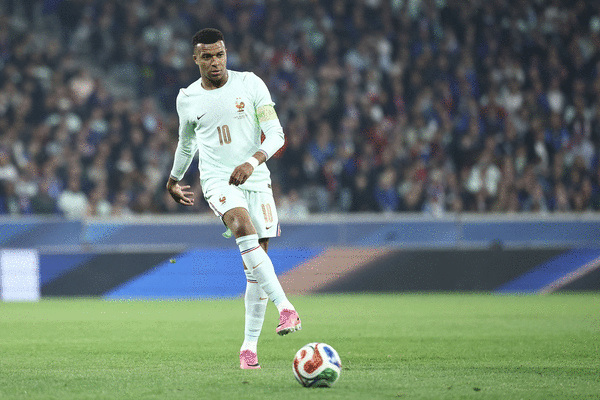
SEATTLE — Welcome to the biggest global sporting event.
New here? No problem. We’ve put together a little explainer to let you know how this whole FIFA Men’s World Cup works.
Please raise your hand with any questions.
How does this all work?
For the first time, the World Cup will feature 48 teams, of which 45 came through qualifying to make the tournament. The three host countries of the United States, Canada and Mexico all received automatic qualification.
In total, 104 matches will be played over the course of 5 1/2 weeks before the final July 19. Sixteen cities across North America will be hosting matches, including the six in Seattle and the seven in Vancouver, B.C.
According to the latest FIFA world rankings, the top 10 teams in the world entering the tournament are: 1) France, 2) Spain, 3) Argentina, 4) England, 5) Portugal, 6) Brazil, 7) Netherlands, 8) Morocco, 9) Belgium and 10) Germany. All 10 have qualified for the World Cup. The three host countries are ranked 15th (Mexico), 16th (U.S.) and 30th (Canada).
The 48 teams were placed into 12 groups of four teams during the draw in December. Each team will play the other three teams in their group. Three points are earned for a victory; one point is earned for a draw. The top two teams in each group automatically qualify for the round of 32.
Unlike the past when only the top two teams in each group advanced to the knockout stage, this time the top eight third-place teams will move on to round out the 32 teams that reach the knockout stage.
The addition of third-place teams advancing to the round of 32 means it would take an unexpectedly dreadful performance for one of the top countries not to reach the knockout stage. Consider that in 2010 (Italy), 2014 (Spain) and 2018 (Germany), the defending champion was eliminated in the group stage after failing to finish in the top two. That’s not likely to happen this time.
The knockout rounds
Once the tournament is reduced to 32 teams, it becomes single-elimination matches where a winner must be determined. If the match isn’t decided after 90 minutes, it will go to extra time featuring two, 15-minute periods. If the teams are still tied, the match will go to penalties (or shootout). In the 2022 tournament, five matches went to penalties in the knockout rounds, including the final.
The round of 16 is where the tournament could really kick into gear with some spicy matchups. France-Germany, maybe? Belgium-U.S. in Seattle? It’s possible. Portugal vs. Mexico? It’s also the final round of the tournament that will feature matches outside of the U.S. The quarterfinals will be contested in Los Angeles, Kansas City, Mo., Boston and Miami. The semis are being played in Dallas and Atlanta. The third-place match will be in Miami and the final is in New York.
Who are the teams most likely to win?
Argentina is the defending champion, but no country has won back-to-back titles since Brazil in 1958 and 1962. The betting favorites are France and Spain. England is also up there, but the Three Lions' only title came 60 years ago.
The other big favorite: Brazil, which is the team that won the title when the World Cup was last played in the U.S. in 1994.
OK, OK, those are the favorites. What about a dark horse?
The reality is a true underdog rarely rises up in this tournament. The closest example in the modern era of the World Cup was Croatia (30/1) making the final in 2018 before losing to France.
Portugal (10/1 odds) could make a run. Same for Germany (14/1). But for a true off-the-radar value proposition in this tournament, try Colombia or Morocco, both at 40/1 odds.
And what about the home team?
The U.S., which will play its second group stage match June 19 in Seattle against Australia, received a mostly favorable draw and should advance to the knockout rounds. From there, it’s a guess. This might be the most talent the U.S. has ever gathered for a World Cup roster, but it’s been a disjointed group with underwhelming performances leading up to the tournament. The U.S. could make a run and realistically get to the quarterfinals, or it could struggle to get out of the group stage. There’s a wide range of potential outcomes for the Americans.
Who are the players to know about?
Cristiano Ronaldo (Portugal) is set to play in a record sixth World Cup. Lionel Messi (Argentina) is still a magician for the defending champions in what's likely to be his last World Cup. Kylian Mbappé (France) is the best player on one of the tourney favorites. Harry Kane and Bukayo Saka (England) will need to score goals if the Three Lions are to make a run.
The best young player in the tournament is likely to be 18-year-old Lamine Yamal (Spain). Norway's goal-scoring machine Erling Haaland gets his debut on the World Cup stage, while Neymar (Brazil) gets one final World Cup opportunity.
Meanwhile, the focus for the U.S. will center on Christian Pulisic and whether the best American player of this generation can have a special tournament.
Impress your friends
Want a couple of little World Cup tidbits to drop while standing around the water cooler at work or watching a match with friends?
Here's two:
— Norway has qualified for the World Cup three previous times before this year, totaling eight prior matches played. But did you know that Norway has lost to only one country across those eight matches? In 1938, Norway's one match was a 2-1 loss. In 1994, the Norwegians lost their second match of the group stage 1-0, sandwiched around a win and a draw, but it wasn't enough to advance to the knockout stage. And in 1998, Norway had two draws and a win (over Brazil) to advance to the round of 16, only to lose 1-0.
The country that's beaten Norway each time? Italy. But the Norwegians are here and the Italians are watching from home.
— What country has hosted the World Cup the most? Surprisingly, it's Mexico as this year will be its third time as a host country. Mexico hosted in 1970 and again in 1986. Colombia was originally set to host in '86 but had to withdraw after the tournament expanded from 16 to 24 teams.
© 2026 The Seattle Times. Visit www.seattletimes.com. Distributed by Tribune Content Agency, LLC.






Comments