Editorial: Minnesota is under siege. This cannot stand
Published in Op Eds
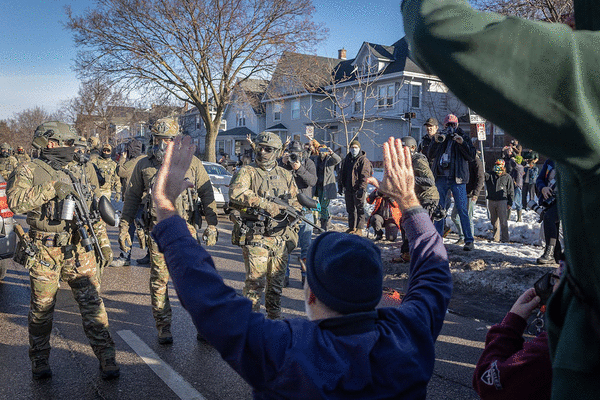
Minnesota has endured unrest before. What the state is now experiencing looks and feels different. Battalions of armed federal agents are moving through neighborhoods, transit hubs, malls and parking lots and staging near churches, mosques and schools. Strangers with guns have metastasized in spaces where daily life should be routine and safe. It feels like a military occupation.
Heavily armed and masked government agents are prone to confront any American they encounter in the street but especially people of certain colors, accents or styles of dress. The encounters are often violent. The federal agents operating under the insignia of Immigration and Customs Enforcement or the Department of Homeland Security, functioning largely anonymously, have disrupted the life of large swaths of a state.
The occupation of Minnesota by ICE cannot stand.
In December, Homeland Security Secretary Kristi Noem announced what the administration labeled “Operation Metro Surge,” describing it as an effort to expose corruption tied to Minnesota’s documented welfare fraud scandal. “We will arrest the criminal illegal aliens hurting Americans,” she said, promising accountability for anyone who “aided and abetted” that criminality.
That is not what Minnesotans are currently experiencing. What we are witnessing is the storming of the state by the federal government.
Fraud investigation and immigration enforcement in Minnesota have become a pretext for a sweeping federal show of force that bears little relationship to the problem it claims to address. It is indiscriminate. Noncitizen immigrants without legal status make up roughly 1.5% of Minnesota’s population — less than half the national average. Nothing about that figure justifies the scale, posture or tactics now widely deployed.
Immigration enforcement in the U.S. is not going away, nor should it. But enforcement carried out without restraint, transparency or proportionality does not strengthen the rule of law. It corrodes it.
The fatal shooting of 37-year-old Renee Good, an American citizen and Minneapolis resident, by an ICE agent on Jan. 7 brought into brutal focus what many communities had already been experiencing: an enforcement strategy that erodes trust and often puts innocent people and lawful protesters in extreme danger. Her death was not an abstraction, nor was it unpredictable. It was the foreseeable outcome of government overreach that seems to prioritize volume and spectacle over judgment and care.
Minneapolis Police Chief Brian O’Hara captured the current angst roiling Minneapolis and much of the state. In an interview with the New York Times, he warned that the behavior of federal agents has undermined the fragile public trust his department has worked tirelessly to rebuild since 2020. “It’s not necessarily about which laws are being enforced,” O’Hara said. “It’s about how that enforcement is happening.”
That distinction matters.
ICE was created in 2003, in the aftermath of 9/11, with a narrow mandate tied to national security, border control and public safety. That mission remains legitimate. What is unfolding in Minnesota, however, resembles something else entirely: a form of militant policing designed to intimidate rather than enforce, to provoke rather than stabilize. Undocumented residents are not the only ones being ensnared. U.S. citizens are, too.
What we’re experiencing is not bureaucratic drift. It reflects deliberate policy choices that favor visibility over accountability and force over legitimacy. It is completely reasonable to ask if such excess would have been embraced by any other presidential administration, even one intently focused on immigration. For many people the question will not be a difficult one to answer.
ICE will not likely be abolished. But, at minimum, it must be reformed. It must be structured to operate within the same constitutional norms that govern other law-enforcement bodies. That means clear rules of engagement. Training must be rebuilt, not lightly adjusted. Rigorous de-escalation training and understanding of the community impact of enforcement actions must be prioritized. The current ambiguity invites overreach and more deaths. Clear limits on force and escalation protect civilians, undocumented residents and agents alike.
Oversight must also have teeth. Independent review, transparent reporting and real consequences for misconduct are essential to restoring trust. ICE should meet the same standards expected of other police agencies, especially as it relates to the identification of agents and use-of-force guidelines.
Public protest and civil disobedience remain essential and foundational tools in a democracy. They must remain peaceful and focused on reform, not escalation. To date, Minnesotans have shown remarkable restraint in the face of disruption and loss. That discipline matters now more than ever. But how long before there is a breach in the face of willful provocation?
The central question ahead is not whether immigration enforcement will continue, but whether it can credibly continue under the current structure and imprimatur of ICE. If battalions of militarized federal agents can occupy American cities under the pretext of combating fraud, arresting undocumented felons and targeting any American seemingly at will without transparency or accountability, then no state is immune.
It is currently happening in Minnesota. It’s wrong, and it must be stopped.
_____
©2026 The Minnesota Star Tribune. Visit at startribune.com. Distributed by Tribune Content Agency, LLC.

















































Comments