Commentary: American diplomacy is in a quiet crisis
Published in Op Eds
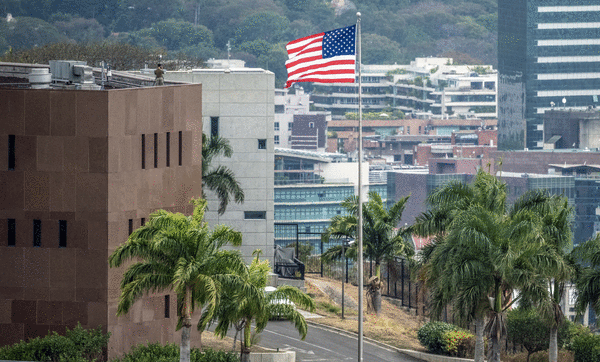
The United States has more unfilled ambassadorial positions around the world than at any point in modern history. Recent reports indicate that 110 to 115 of the United States’ 195 ambassadorial posts remain vacant, a vacancy rate approaching 60 percent.
These aren’t just vacancies in small, relatively unimportant countries. Right now, the war between Russia and Ukraine is in its fourth year, and President Donald Trump promised to end it on day one of his second term. However, we have no ambassadors in either Russia or Ukraine. And with the Iran war in the Middle East and the Gaza conflict still simmering, we have no ambassadors in Saudi Arabia, Qatar, the United Arab Emirates, Iraq or Kuwait, all countries that have been deeply affected by the war and that all have a stake in how it might be brought to an end. In addition, as reported by the Wall Street Journal, 37 of 51 ambassadorial positions in Africa are unfilled.
This is not normal. Why should we care?
Diplomacy is important — even in our personal lives. If you have ever had some tension in a relationship, you know that keeping the lines of communication open is important. Once you stop talking, misunderstandings can escalate.
Also, if you hope to resolve that tension, you need to understand the person with whom you want a better relationship and speak to that person carefully and respectfully. If people in a relationship stop communicating, insult each other or fail to listen to each other, it is unlikely the relationship can be salvaged. It can easily deteriorate into conflict. Diplomacy matters.
The same is true for diplomacy in international affairs. Countries need ambassadors who understand the country assigned to them and who work to build relationships with high-ranking officials in that government. And ambassadors need to be available to convey complex messages with tact and understanding of their counterparts. This keeps the lines of communication open between countries, and it makes it less likely that a misunderstanding will snowball into tension and conflict.
The legendary diplomat George Kennan argued that diplomacy is about communication, but he stressed that it was not just about what is communicated; it is about how it is communicated. And learning the how of diplomacy requires serious, committed study of the country, people and governing principles of the country to which they are assigned.
So having ambassadors in other countries — allies and enemies — is absolutely crucial for managing relationships. The United States needs ambassadors — people dedicated to understanding the complexities and nuances of their host countries. We need their expertise. When we allow a 60% vacancy rate, we put ourselves at risk. This is a real crisis, but it is a quiet one, because our diplomats work for us behind the scenes. We don’t see what they do.
How have we allowed this to happen? There are multiple explanations.
Ambassadors need to be confirmed by the Senate, and the intense polarization in Congress has slowed everything, including confirmation hearings. In addition, Trump recalled 30 ambassadors because he did not think they were fully committed to his America First perspective. Whether this was a wise or prudent decision, the president does have the legal authority to do so.
These explanations are not sufficient. The fact is that Trump has not nominated many people for the positions. It is true that he has had a busy second term, but we are now 17 months into it, and still the vacancies persist. Why is this?
There is no way to know for sure, and speculating about this can easily lead one down a partisan rabbit hole. One thing is clear: for one reason or another, diplomats are not a priority for Trump. If he believed they served an important purpose for the United States, it would be a priority.
We don’t need more finger-pointing. It is more important to address this crisis in diplomacy than to determine who is responsible for letting it happen.
The United States may like the idea of being strong and independent, of not needing other countries. However, in the modern world, we are all connected, whether we want it or not. America needs allies, and we need to be able to communicate civilly with competitors and even enemies. Diplomacy performs an essential but quiet role in supporting American interests. If we fail to keep a vibrant, well-staffed, and qualified diplomatic corps, we make our world a more dangerous place.
_____
ABOUT THE WRITER
Solomon D. Stevens is the author of “Religion, Politics, and the Law” (co-authored with Peter Schotten) and “Challenges to Peace in the Middle East.” He wrote this for InsideSources.com.
_____
©2026 Tribune Content Agency, LLC.







































Comments