Federal judges seek to appoint U.S. attorney in Seattle
Published in News & Features
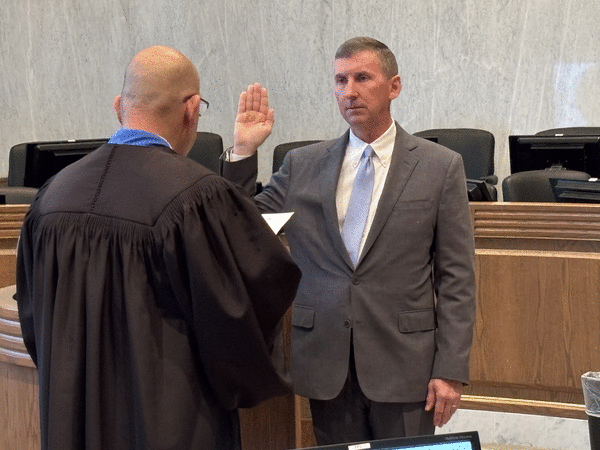
Federal judges in the Western District of Washington plan to appoint a new U.S. attorney when the term of acting U.S. Attorney Charles Neil Floyd expires next month, setting in motion a potential clash with the Trump administration and Attorney General Pam Bondi.
Floyd, a controversial and tough-minded immigration judge, was appointed acting U.S. attorney in October, amid outcries by immigration officials and without consulting the state's senior senator, Patty Murray.
Murray on Wednesday said she opposes Floyd's appointment to the post.
“Charles Neil Floyd has a track record of denying bond for immigrants who pose no threat to our communities. I was not consulted on his temporary appointment as interim U.S. Attorney and, if he were to be nominated for a Senate-confirmed position, I would block his appointment, she said. "I will oppose any candidate who does not align with Washington state’s values.”
Floyd did not respond to an email seeking comment on the judges' action. The Department of Justice also did not respond to a request for comment.
In an order posted Wednesday morning on the court's website, Chief U.S. District Judge David Estudillo wrote that the judges — who have the power to appoint a U.S. attorney absent a formal presidential nomination with advice and consent from the U.S. Senate — will begin taking applications for the district's new top prosecutor next month.
Candidates will be given preference if they provide their applications before March 16, the order says. The order does not preclude Floyd from applying for the job.
The judges in the Western District of Washington have used this method before to appoint the two prior U.S. attorneys, Annette Hayes and Tessa Gorman.
Federal law requires that U.S. attorneys, as chief federal law enforcement officials, be appointed by the president — usually after consulting with the senior senator of the state — and then sit before the Senate Judiciary Committee for approval. If that is granted, the nominee's name goes before the full U.S. Senate for a vote that must pass by a simple majority.
However, U.S. Code 546 allows the attorney general to appoint an acting U.S. attorney for up to 120 days, a term that expires for Floyd on Feb. 3. President Donald Trump and Bondi, his attorney general, announced in October that Floyd would be the acting top prosecutor in Seattle.
The administration has made no move to formally nominate Floyd and advance his name to the Senate, triggering a section of the law that allows the district's judges to appoint a U.S. attorney until the position is filled by the president and goes through the confirmation process.
A similar controversy arose around the appointment of Pete Serrano as U.S. attorney in the Eastern District of Washington in Spokane. Serrano’s confirmation was considered unlikely due to strong opposition from Murray, who argued that he was unqualified and vowed to block him.
Bondi employed a controversial workaround by appointing Serrano in the role of "first assistant U.S. attorney. Serrano continues to lead the office in that role today.
Murray criticized the move as an “end run around the Constitution,” warning that it could undermine the office’s legitimacy.
As a judge, Floyd began hearing cases at the Tacoma Immigration Court in October 2018. From 2009 to 2018, Floyd was an assistant chief counsel with U.S. Immigration and Customs Enforcement in Tacoma. From 2004 to 2009, he served as an assistant U.S. attorney in Washington, D.C. And from 1998 to 2004, Floyd was a judge advocate with the U.S. Army. He has a law degree from the University of Arkansas School of Law.
The Tacoma immigration court where Floyd practiced has been part of a national controversy over whether federal judges can issue bond to release detained people pending possible deportation in some cases. The federal courts have ruled they can, however Floyd and others have said those rulings are advisory only and that immigration courts have the final say.
_____
© 2026 The Seattle Times. Visit www.seattletimes.com. Distributed by Tribune Content Agency, LLC.






Comments